


Ride
- For
- 1 to 3 passengers
- Fare
- Standard
Everyday rides
OOS Ride is a complete rideshare job for FiveM. Your players sign up as drivers, take requests, pick people up from the pavement, drive them across Los Santos and get paid, rated and reviewed for how it went. The person in the back seat is an artificial intelligence (AI/SI) passenger or one of your own players.
Every ride has someone in the back seat.
Artificial intelligence (AI/SI) passengers are generated people with names, faces, moods and a reason for going where they are going. You talk to them out loud through your server's normal voice chat, and they answer fast, in a voice of their own. They ask you for the radio. They notice when you speed. They leave a review that says what actually happened. And much more.
Players book their rides from the rider side of the same app, with one account and two profiles, and both sides rate each other. Everything is run from one admin panel, in plain language, under your own brand.
Voice
Your voice chat is the interface.
Press your usual push to talk key, say something, let go. The passenger answers out loud from the back seat almost straight away, and the subtitle runs in step with the voice. There is no extra talk key, no separate microphone setup and no dialogue wheel. It listens through the voice chat your server already runs, only to the driver, and only while they transmit in proximity. Radio and phone calls never reach a passenger.
Everyone nearby hears the passenger as well. The voice is placed where the passenger sits and fades the way your server's own voice settings fade a real player, so somebody standing next to the car hears both halves of the conversation and loses it as they walk away.
You can changeHow talkative passengers are, how long the talk key may stay open, and whether passengers have a voice at all.
Passengers
Who turns up depends on the hour and the street.
Every civilian ped model in the base game is in the pool, 404 of them, and every one is described. Somebody in a balaclava knows how they look. A builder in hi-vis is on the way to the site at six in the morning. A pilot is found at the airport and bar staff own the night. On top of the person sit unlimited personalities, unlimited ways of speaking and unlimited things to talk about, drawn fresh for every ride, so the eighth passenger of a shift is not the first one again.
Office workers at eight, a lunch break at one, people going out in the evening, the walk home from the bars at three with a drink or two in them.
03:00 The walk home from the bars, with a drink or two in them.
06:00 A builder in hi-vis on the way to the site.
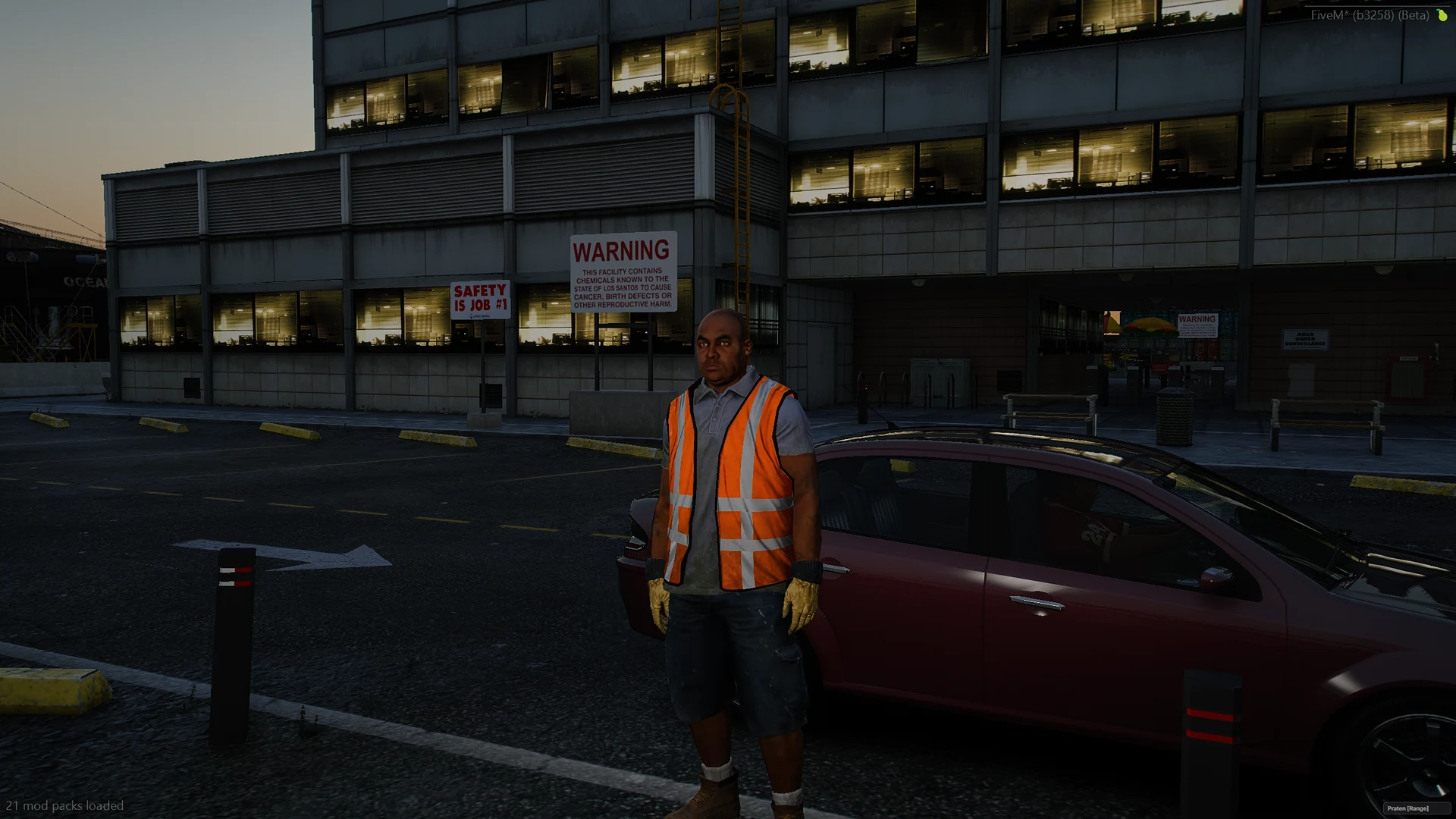
08:00 Office workers. At the morning rush most passengers are on their way to work.
13:00 Somebody out on a lunch break.
Evening People going out.
Night Bar staff own the night.
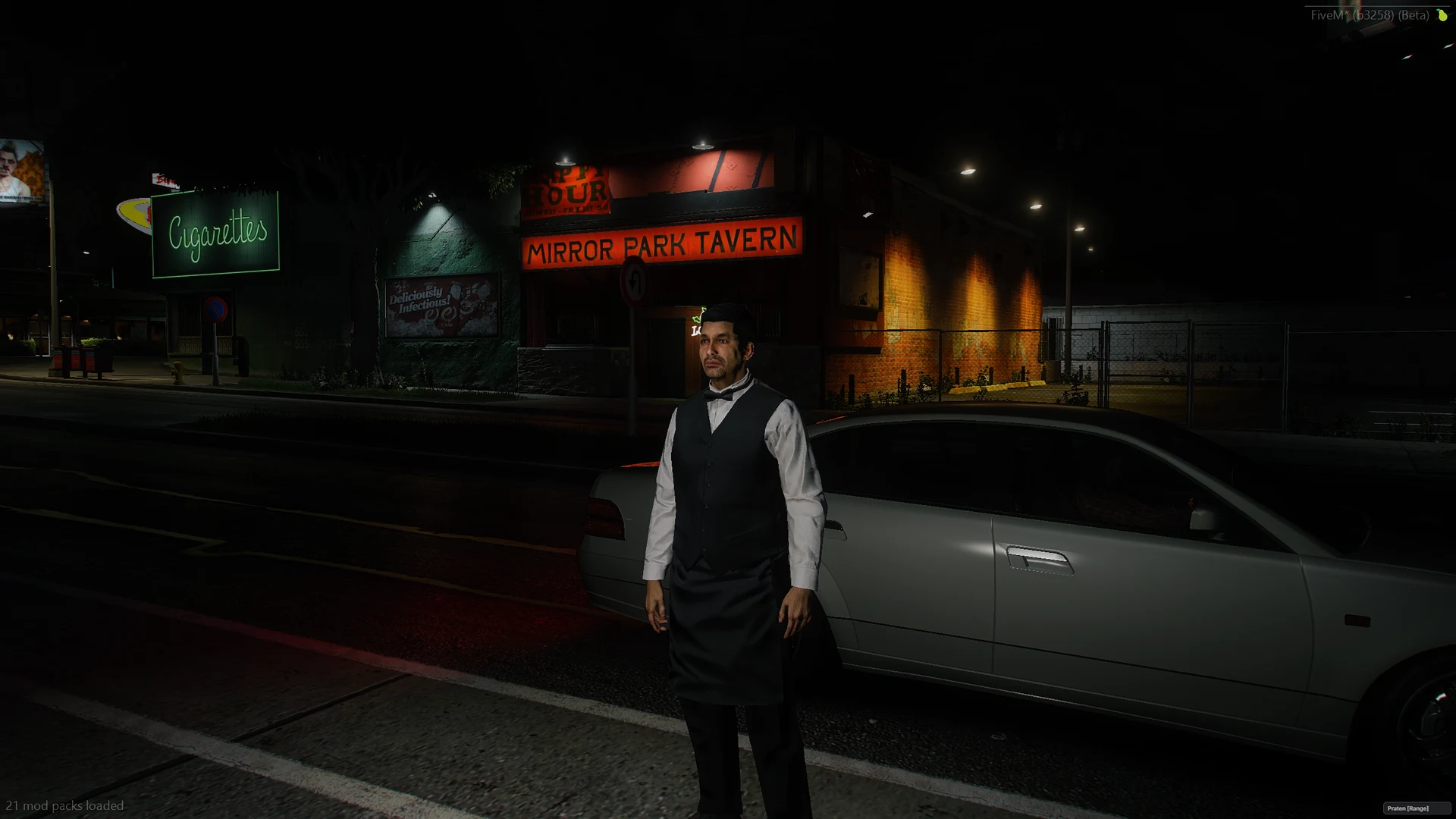
You can changeSwitch cultural flavour and appearance on or off, and edit the personalities, ways of speaking, subjects, roles and more.
Groups
Up to three people, three voices.
A group shares one booking. They ask whether the ride is for all of them, by name, and when everybody is in the car they talk like people who know each other. Each has a voice, a personality and a way of speaking of their own, and a companion takes a line of their own, not a copy of the first person's.
3 = 1A group of three costs the same number of artificial intelligence (AI/SI) requests as one passenger.
Driving
Warned first, then rated for what really happened.
Push the speed and they ask you to slow down. Ask again and they mean it. Hit something and they cry out, with a face to match. Get out of the car mid trip, take the long way, turn up in a wreck, sit parked for five minutes, drive with a door hanging open: each one is something they see, say out loud and warn you about before anything happens. Nobody walks out on a driver without a warning, and how much they put up with depends on who is in the back seat.
You can changeEvery rule has a switch and its own numbers.
Requests
A request in their own words, and a thank you when you do it.
2 in 3About two rides in three, a passenger asks for something.
They ask for the radio on, off or on a particular station, or for a quiet ride. The request shows in the app in their own words with a soft cue. Do it, and they notice, and it goes in the review. Ignore it twice and that goes in the review too.
Luggage
1 in 4About a quarter of passengers carry something.
A suitcase for a flight, carrier bags for the weekly shop, a gym bag, a rucksack. The boot opens as you pull up, they load it themselves, it shuts, and then they get in. At the other end it opens again and they take their things out. The time they spend loading never counts against your pickup wait. A car without a boot carries the small things on a lap.
You can changeHow often passengers carry luggage, and the boot size per vehicle.
Arrival
They finish the sentence, or break off in the middle of it, the way people do.
Arrive while they are talking and they stop, notice you are there and say goodbye. The door opens, the boot opens, they take their bag and walk away along the pavement and into the city. Nobody is deleted in front of a player.
Map
Every road, every street name, light or dark.
The driver app draws Los Santos itself. The land comes from tiles that ship with the product, every road is a sharp line with its street name written along it, and the route the game's GPS is following is drawn on top. On a job it is a navigation view, behind your car with the heading up. The compass flips it to north up, one button frames the whole route, and dragging the map hands the camera over until you send it back to the car. Pan, pinch and zoom.
The same map sits in the trip widget, which stays on screen while the phone is shut, with the arrival time, the minutes and distance left and who is in the car.
Around the ride
One account, two profiles, one switch.
Switch to Rider and the same app becomes the one you book with. Drop a pin, see what each service costs before you commit, watch your driver arrive with their name, face, car and plate, and rate them at the end. They rate you back.
A player's request jumps in front of a generated one, and the driver loses nothing by it. The fare is taken when the driver accepts, so a driver is never left unpaid by a rider who was solvent when they ordered and broke on arrival.
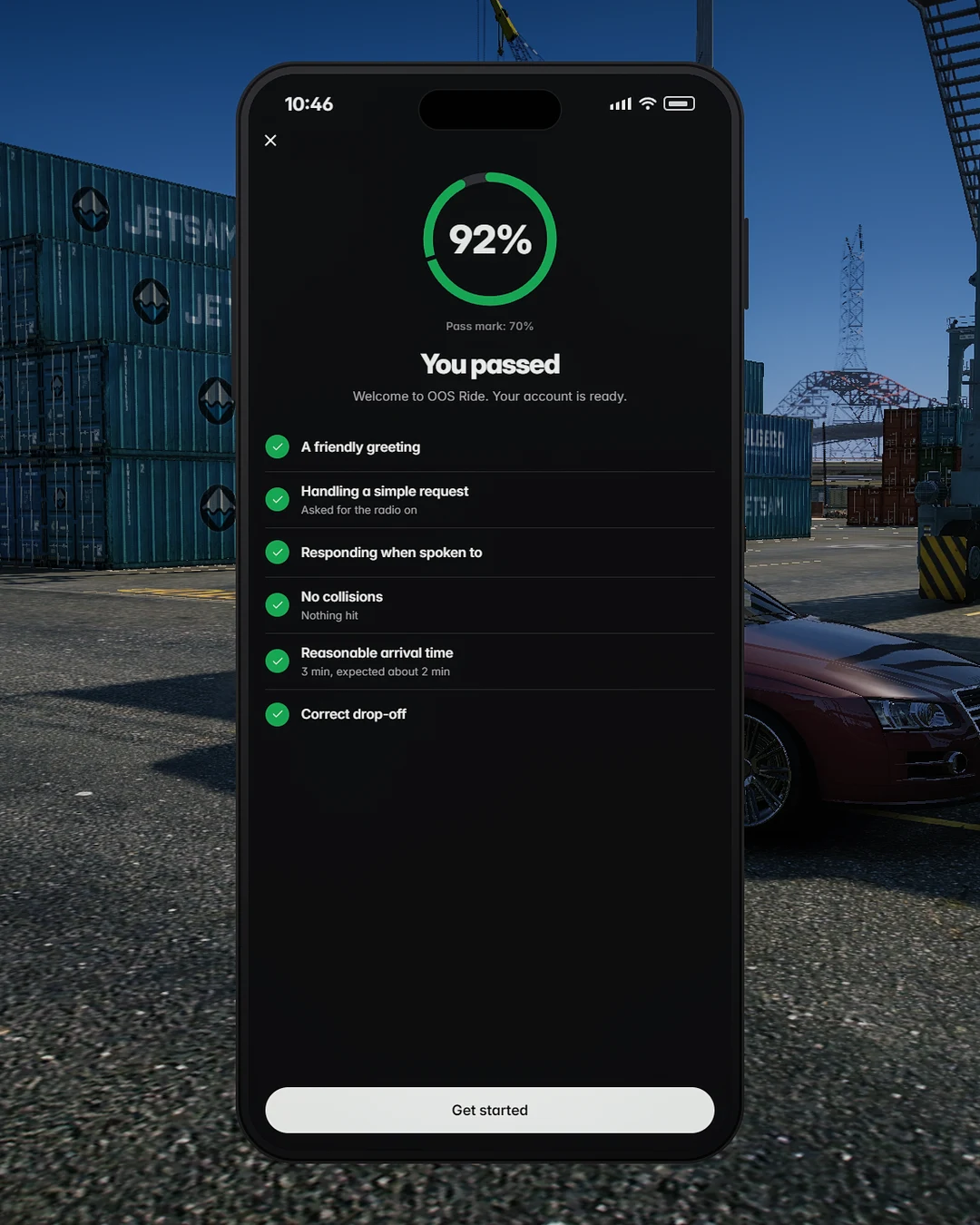
Sign up in minutes, get tested on a real ride, grow into bigger services.
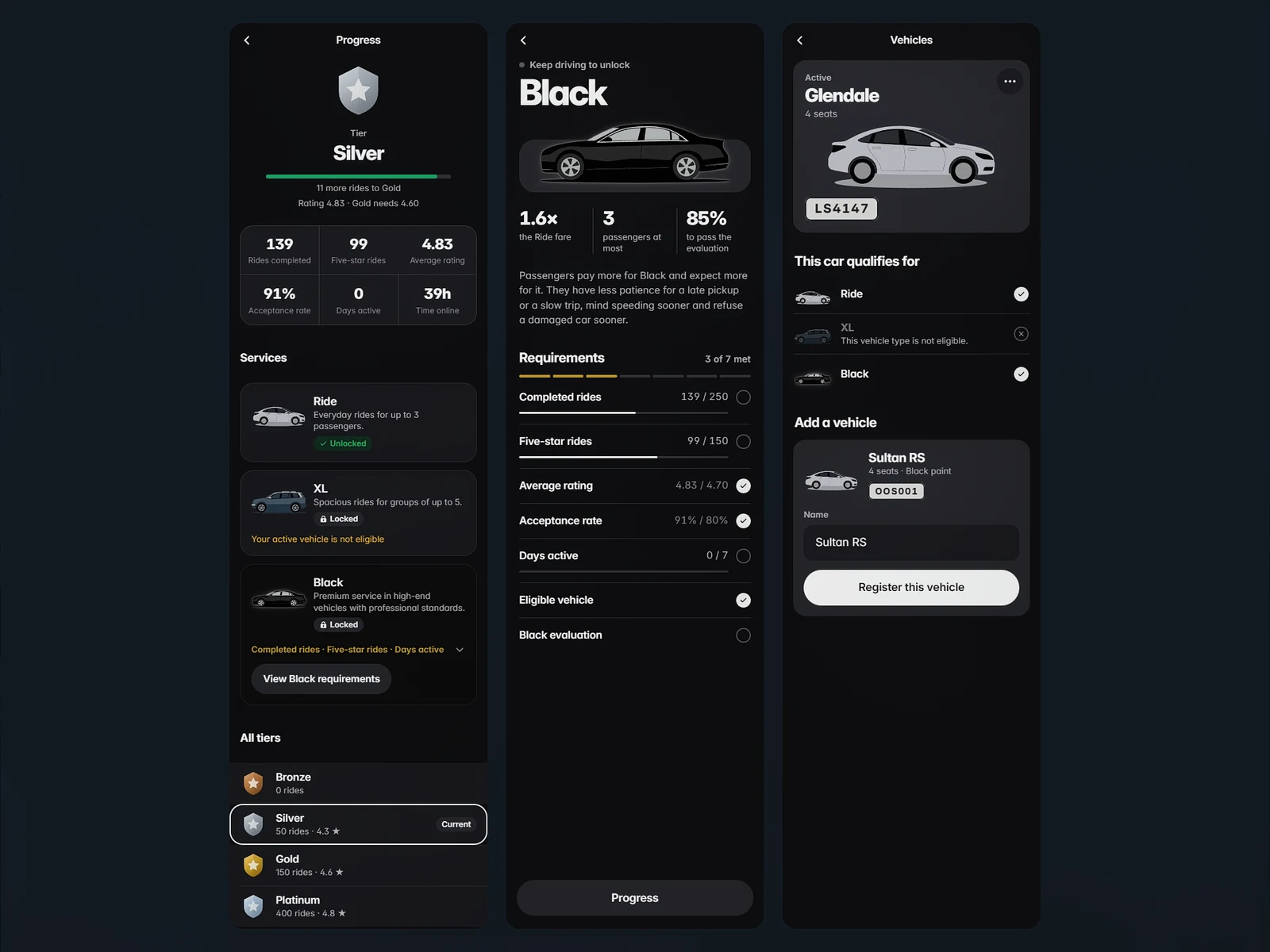
From there every ride builds a profile: earnings, history, ratings and reviews. Reach the standard and new services open up.
You can changeThe services, vehicle classes, requirements, fare multipliers and the evaluation.
Everyday rides

Needs a vehicle with enough seats

A premium tier with its own application, its own evaluation, higher expectations and higher fares
The multipliers are the defaults. You can change them, and the vehicle classes and requirements for each service.
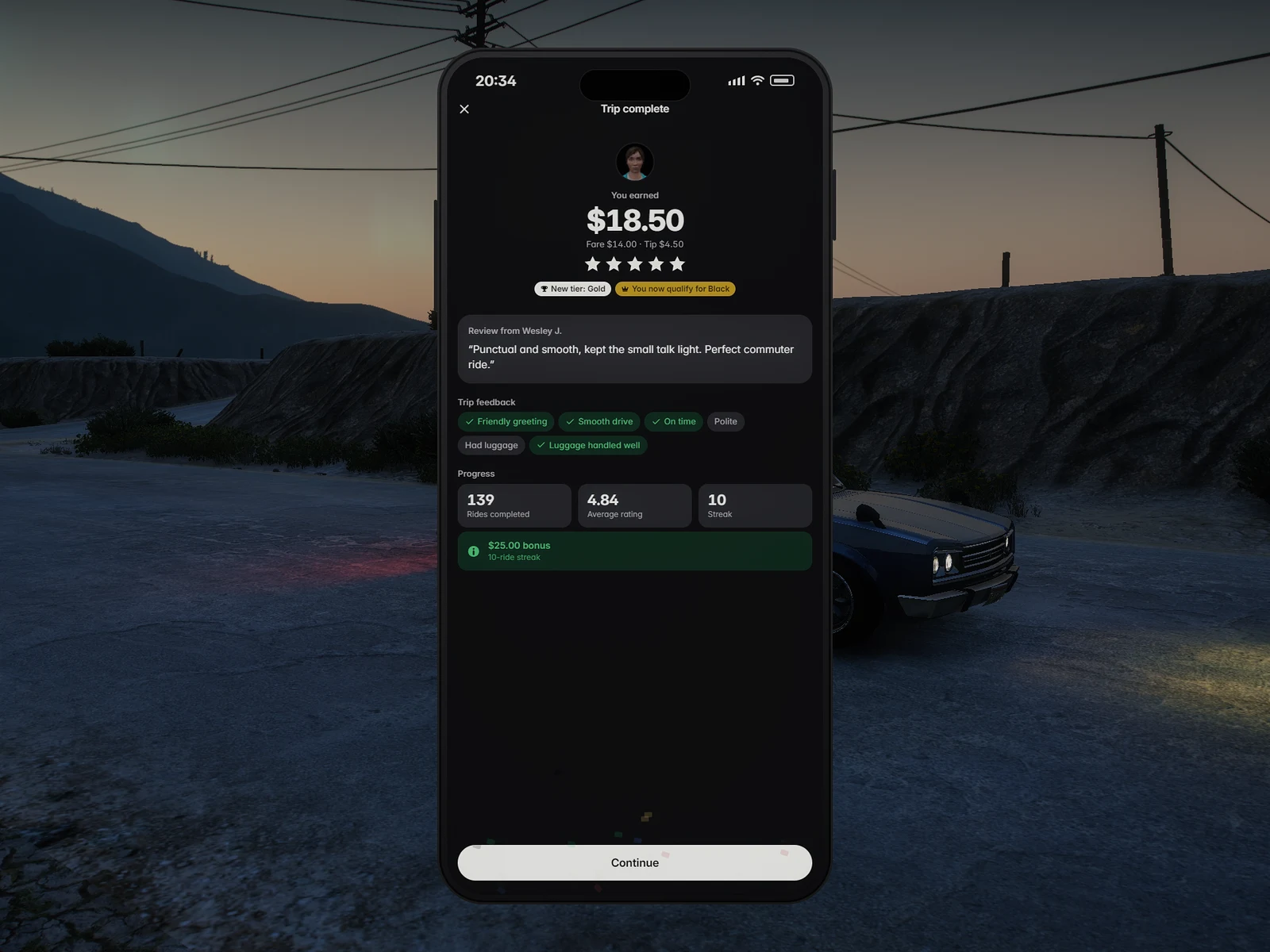
A review cannot contradict the ride.
Reviews are put together from what actually happened on the trip. There are hundreds of authored lines and parts to build from. A ride on which the driver hit a lamp post cannot come back as smooth.
What a review is built from
Every setting in plain language, saved once.
The admin panel puts every setting on a page with a line under it saying what it does, and hides the ones that do not apply to your setup instead of explaining them. Change what you want, press save once, and everything is checked as a whole before anything is written.
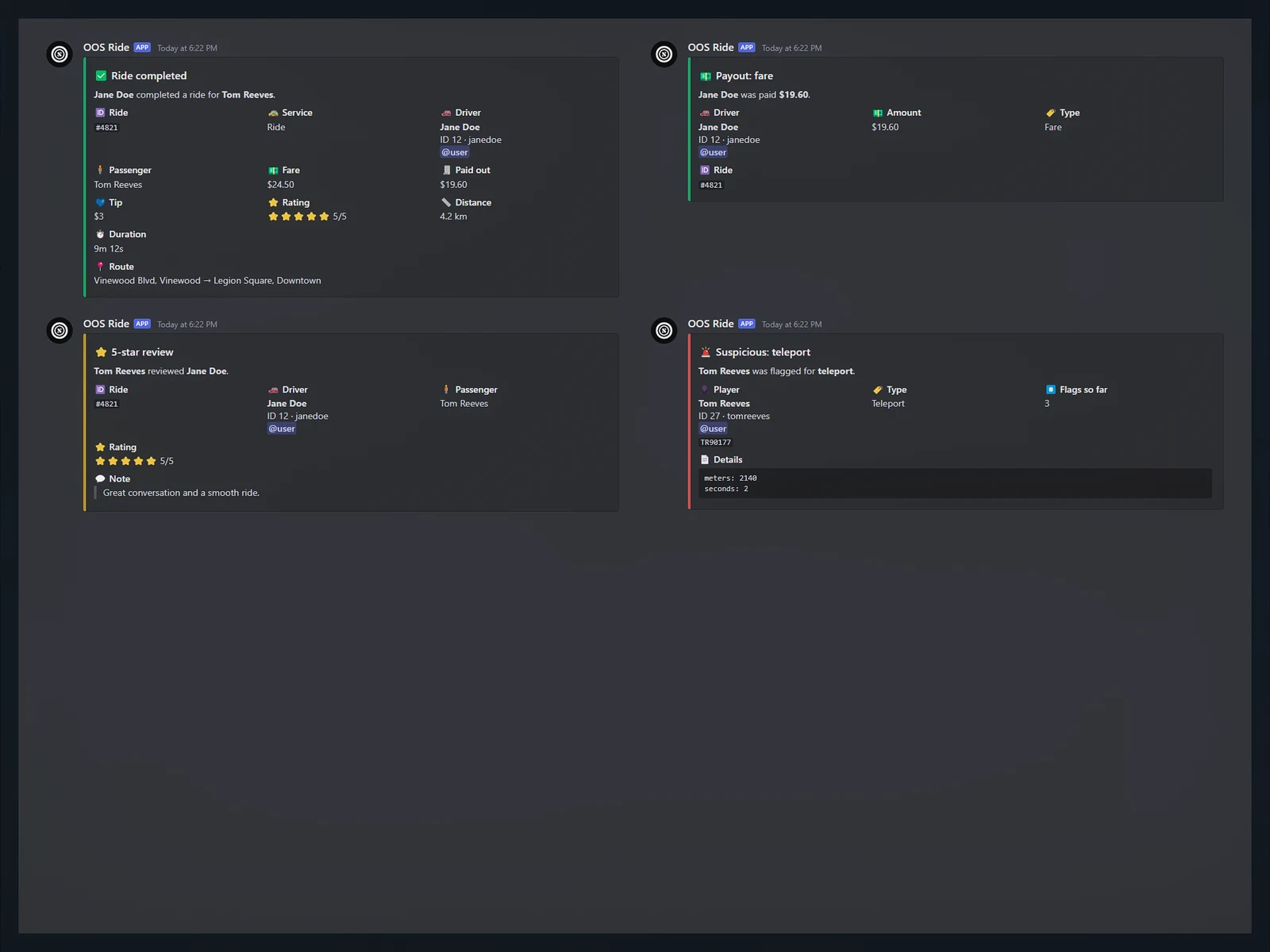
50+events, to Discord, to Fivemanage or to both.
They cover sign-ups, rides, payouts, reviews, staff changes, security flags and Auto Cab bookings. Each category can have its own channel and role ping, every event has a switch, and titles, colours and fields can be changed.
Artificial intelligence (AI/SI) and what it costs
About 1.5 cents of artificial intelligence (AI/SI) a ride on the default setting. You decide how much your passengers talk, and you can cap the spend per ride, per player and per day.
You speak.
Your words are transcribed as you talk, over a streaming connection opened with a short-lived secret. The API key never reaches a player.
A model writes the reply.
Pick OpenAI, Anthropic or DeepSeek as the main model, and a second one as the fallback. One request per turn, however many people are in the car.
A voice says it.
xAI speaks the line in a voice picked to fit the passenger (gender, age, energy), with a delivery that matches the moment: calm, amused, annoyed, scared.
Everyone nearby hears it.
Placed where the passenger sits, faded like a real player.
From the driver letting go of the key to hearing the answer: two to three seconds. Almost as fast as a real conversation with another person.
A normal ride is 17 passenger replies and 8 driver turns. Estimates in US dollars, from list prices read on 7 October 2026 and token counts measured against the live services.
| Mode | What changes | Per ride | Per 1,000 rides |
|---|---|---|---|
| Balanced Default | One sentence replies, talk key capped at 15 seconds | about 1.5 cents | about $15.00 |
| Saver | Passengers start fewer conversations of their own | about 1.2 cents | about $11.90 |
| Minimal | No small talk, key moments voiced | about 0.7 cents | about $6.70 |
| Voice off Subtitles | Everything the same, no voice | about 0.3 cents | about $2.70 |
On Balanced, one ride to the next
04 cents
| Detail | OpenAI gpt-6-lunaRecommended |
Anthropic claude-haiku-5-5 |
DeepSeek deepseek-flash |
|---|---|---|---|
| Role | Main model, recommended | Alternative or fallback | Alternative or fallback |
| Input, per million tokens | $0.10 | $0.10 | $0.15 |
| Reused prompt, per million tokens | $0.01 | $0.01 | $0.003 |
| Output, per million tokens | $0.50 | $0.50 | $0.60 |
| Typical reply time | about 1.5 seconds | about 1.4 seconds | about 1 second |
| Fast mode | Yes, off by default. It doubles the word cost for a small gain, so it is not recommended | No | No |
OpenAI gpt-6-lunaRecommended
Anthropic claude-haiku-5-5
DeepSeek deepseek-flash
The voice costs $15 per million characters, and a spoken line is 50 to 70 characters. Listening costs $0.20 per hour of streamed audio, so half a minute of the driver talking costs well under a cent.
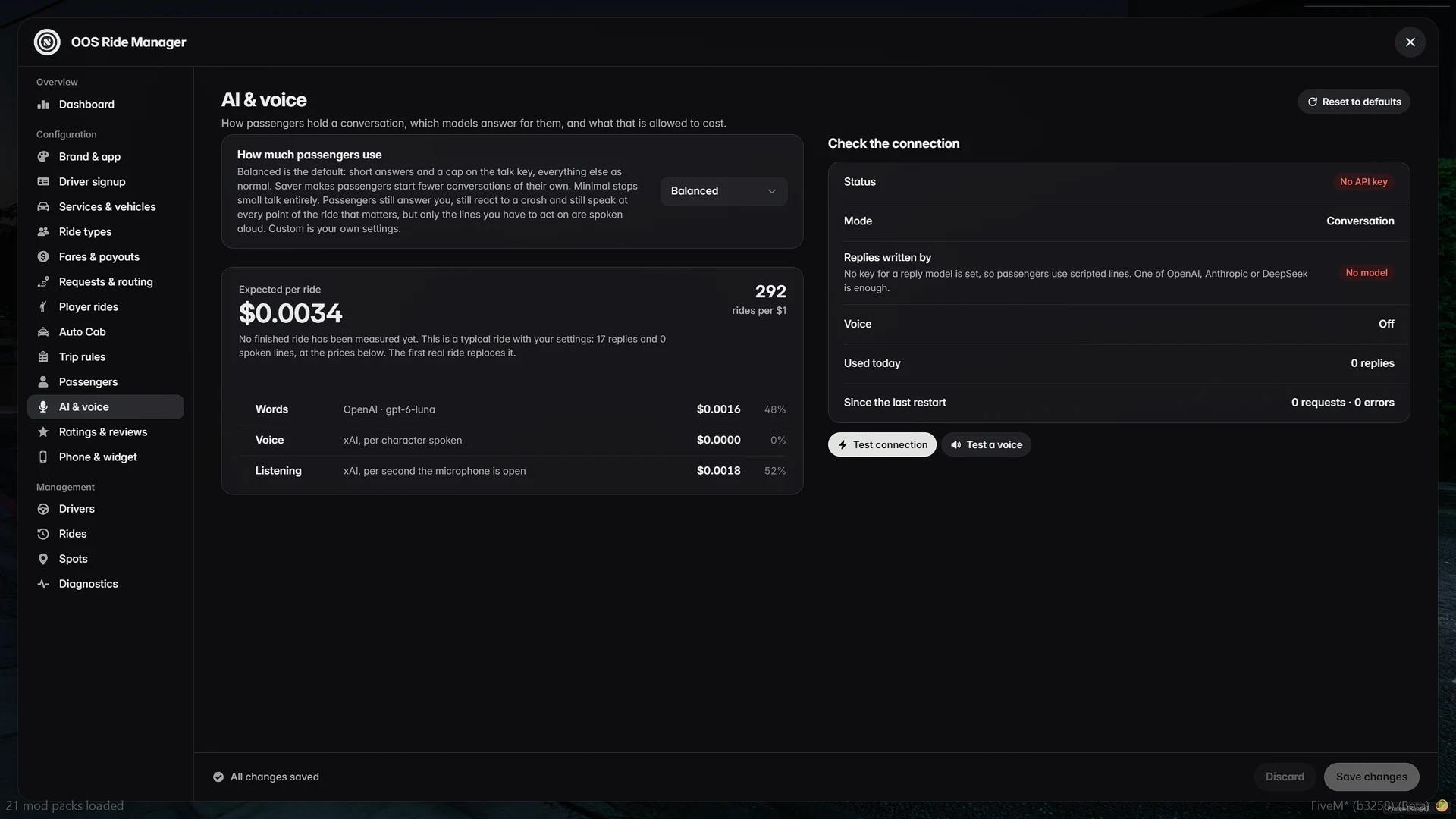
Estimates from list prices read on 7 October 2026 and token counts measured on the live services. The admin panel replaces this estimate with the average of your own finished rides, read from the providers' own meters.
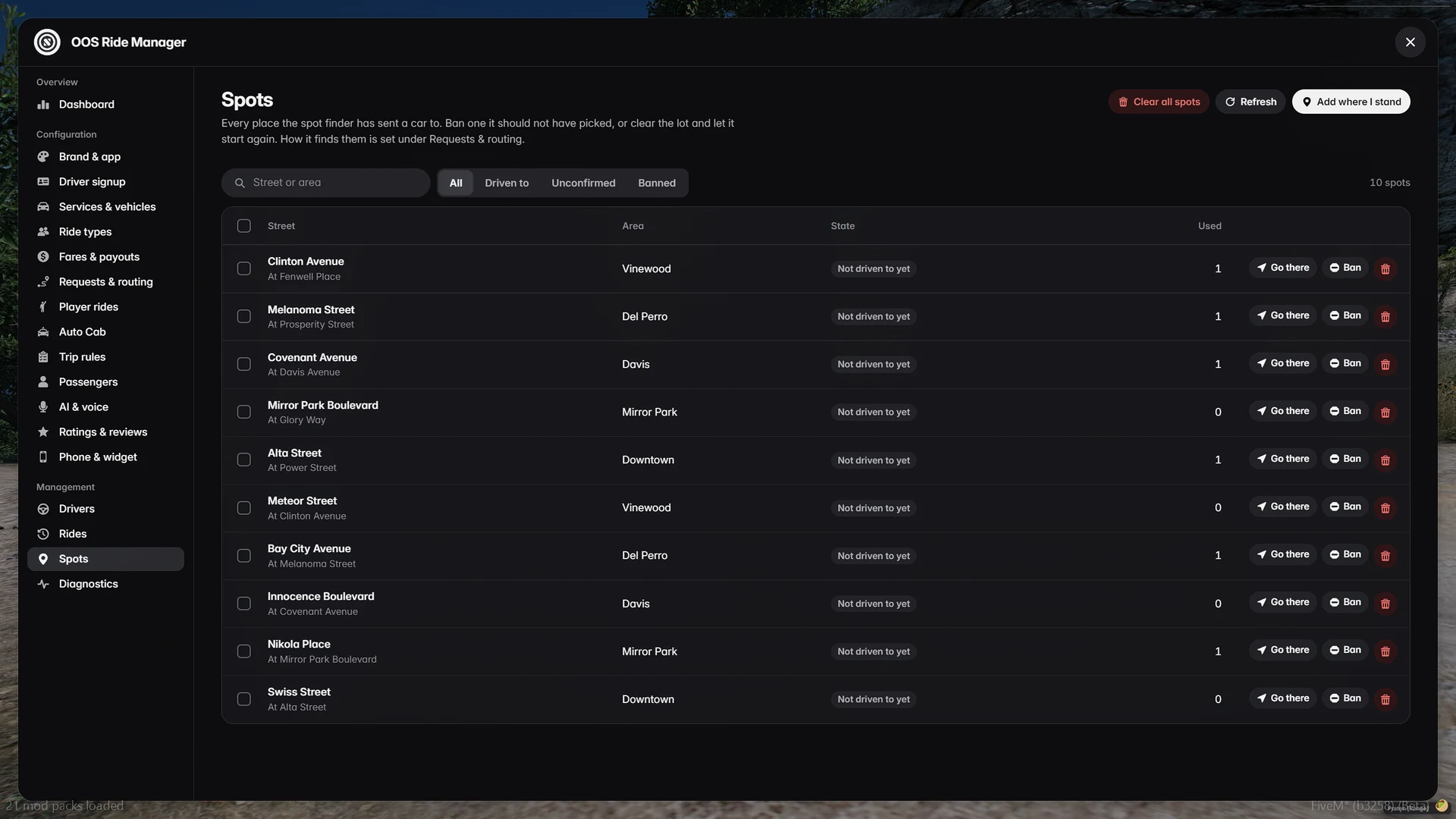
There is no catalogue of pickup points. Each spot is found while players drive, checked as a real road a car can reach, and remembered. A driver is never sent twice to a place they already had while anywhere else will do. Never on a freeway, in a junction, in water or inside the military base.
The app, the admin panel, the notices, the authored lines, the reviews, the language passengers speak, the voices and the transcription all follow the server's language.
Arabic has full support: the app, the admin panel and every text are mirrored to read from right to left. More languages may be possible: open a ticket.
Fourteen cues in one musical key. A new request is loud enough to hear over an engine, and nothing else is. Drivers get a volume and an off switch. Nothing borrows the game's menu sounds.
It ends on the spot. Nobody is blamed for what the server cannot prove, and the ride is neither rated nor charged as an ordinary one.
A crash is a shout, a detour a tut, a favourite song a hum, with a face to match.
Name, colours, logo and every line of text, in one place. Notices come through your own notification system.
Pick what your server runs and see how OOS Ride fits in.
Every server also needs a recent FXServer artifact with OneSync on, and oxmysql. Something missing from the list? Open a ticket
| Part | Supported | Notes |
|---|---|---|
| Framework | QBCore, Qbox, ESX, or standalone. A custom framework can be added | Detected automatically. Standalone keeps a ledger instead of paying through a money account, and does not ship with every feature |
| Database | oxmysql | Set up by itself on first start |
| FXServer | A recent artifact with OneSync on | Passenger peds are created by the server |
| Voice chat | pma-voice (recommended), mumble-voip, SaltyChat, TokoVoIP, built-in FiveM voice | It listens to your voice resource and never changes it |
| Notifications | Your own notification resource, or the built-in one | oos-notify, wasabi_notify, okokNotify, ps-ui, ox_lib, qbx_core, qb-core and esx_notify are recognised |
The bundled phone works on every server. Support for more phones may be possible: open a ticket.
| Account | What it does | Needed |
|---|---|---|
| xAI account | Transcribes the driver and speaks the passengers | For voice and listening |
| OpenAI, Anthropic or DeepSeek account | Writes what the passenger says | One is enough, but two are recommended |
| Discord or Fivemanage | The staff log | Optional |
For a full conversation, yes: an xAI account for the voice and listening and one reply provider (OpenAI, Anthropic or DeepSeek). With no reply provider passengers use authored lines. With no xAI account they have no voice. The ride works either way.
About 1.5 cents (US dollar) on the default Balanced mode, about 1.2 cents on Saver, under a cent on Minimal and about 0.3 cents with the voice off. The admin panel measures your own average from the providers' meters.
OpenAI gpt-6-luna is the recommended main model. The choice moves the price by a fraction of a cent, because the voice is most of the cost. If you pick Anthropic's model, set a fallback, because it can decline a line on its own safety checks.
Yes, per ride, per player and per day. Reaching a cap does not break a ride. The passenger switches to authored lines for the rest of it.
QBCore, Qbox and ESX are detected automatically, and standalone works without a framework, though it does not ship with every feature. There is also support to add a custom framework. The bundled phone works everywhere, and the app can also be added to LB Phone, SD Phone, GKSPhone v2, YSeries and okokPhone. Support for more phones may be possible: open a ticket.
Yes. One account has a driver profile and a rider profile, and a person's request goes ahead of a generated one.
Yes. Personalities, ways of speaking, subjects, cultural backgrounds, what each ped model looks like and the roles are all editable.
Yes. Name, colours, logo and text are settings, and notices go through your own notification system.
Arabic (with full support: the app, the admin panel and every text read from right to left), Czech, Danish, German, English, Spanish, French, Hungarian, Italian, Japanese, Lithuanian, Dutch, Polish, Portuguese (Brazil and Portugal), Romanian, Swedish, Thai, Turkish and Chinese. More may be possible: open a ticket.
No. The Auto Cab is an optional add-on that needs OOS Ride, and OOS Ride is complete without it.
OOS Ride
Rideshare where the passenger talks back.
Support and licences at oos-scripts.com.
 Add-on for OOS Ride
Now add a car with nobody in it.
OOS Auto Cab adds driverless cabs to OOS Ride. Riders book one in the same app, watch it arrive and step in through a door that opens by itself.
See OOS Auto Cab
Connect your Discord account to automatically claim your Customer Role, get priority support, and access exclusive server giveaways!
